Pathways Setup enables districts to define Career Technical Education (CTE) Pathways, with any sub-pathways, and associate the pathway with its industry sector. When defining a Pathway, courses are selected, and for each course a level will be designated (e.g. Introduction, Concentrator or Capstone.) Three examples of CTE Pathways from the ‘Business and Finance’ Industry Sector include: Business Management, Financial Services, and International Business.
Students may be enrolled in one or more pathways using the Student Pathways application. The Student Career Plans application may also be used to set a student’s pathway and courses.
Pathways are district-defined and not school-specific, so you may create Pathways from a District or School track. A Pathways Listing report is available under Schedule Reports.
Pathways Setup is located under the Schedule menu in Q.
When initially setting up Pathways, the Pathway list will be empty.
- Click Add to create a Pathway.

From the Add Pathway screen, notice that Pathway field and Year field are highlighted as required fields. Pathways are uniquely identified by their name and year.
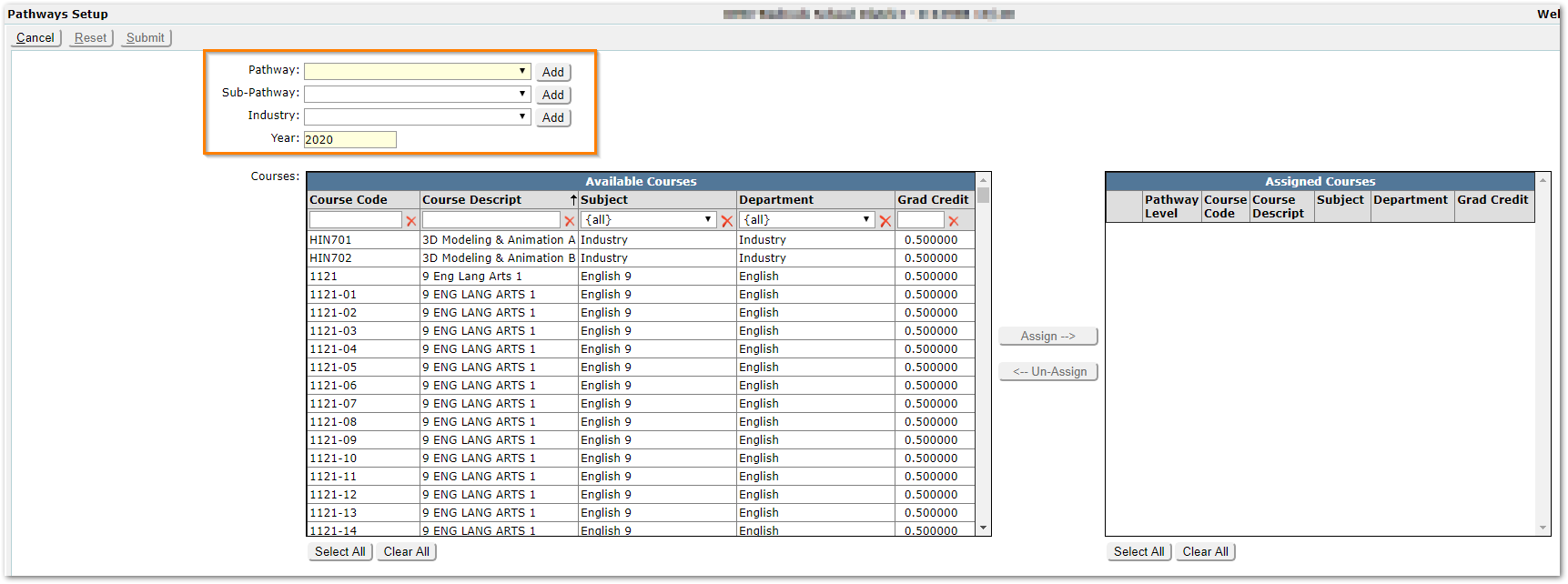
- Click the Pathway dropdown and review the choices. If your choice is available, select it.
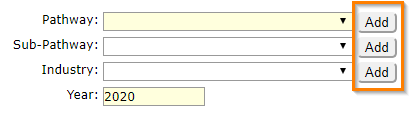
If it is not available in the list, you may instead click the Add button to the right of the field and create the Pathway Lookup entry you want to use.
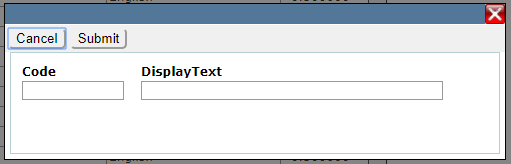
When you click Add beside the dropdown, the Lookup Code entry screen will appear, as shown. Enter the desired code and description of name of the value in the DisplayText field. Save the change by clicking Submit.
Notes: Alternatively, the CTE Pathway related codes may be accessed through Lookup Codes application.
For California districts, the state codes and pathways were provided with Pathways Setup. For other states, it may be helpful when defining new Pathways to use valid state codes for state reporting purposes.
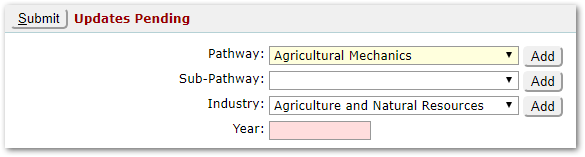
- Use the dropdowns and set the Pathway, Sub-Pathway if applicable, and Industry.
- Notice that the Year defaults to the current school year. Pathway definitions may change over time. If a Pathway’s course requirements change, make a new version of it and set the Year to reflect the effective year for the requirements.
Note: When initially implementing Pathways, districts may need to honor more than one version of a Pathway if requirements changed during the period of time that upper level students commenced a Pathway and current freshman, or sophomores, began. In that case, define both versions of the Pathway, setting each with appropriate year values, i.e. Financial Services, 2010 and Financial Services, 2018 or whatever year course requirements came into effect for the Pathway.
In this example, we are setting the Year back to 2016 since the Pathway requirements for Engineering Design, in our district, have been in effect since that time.
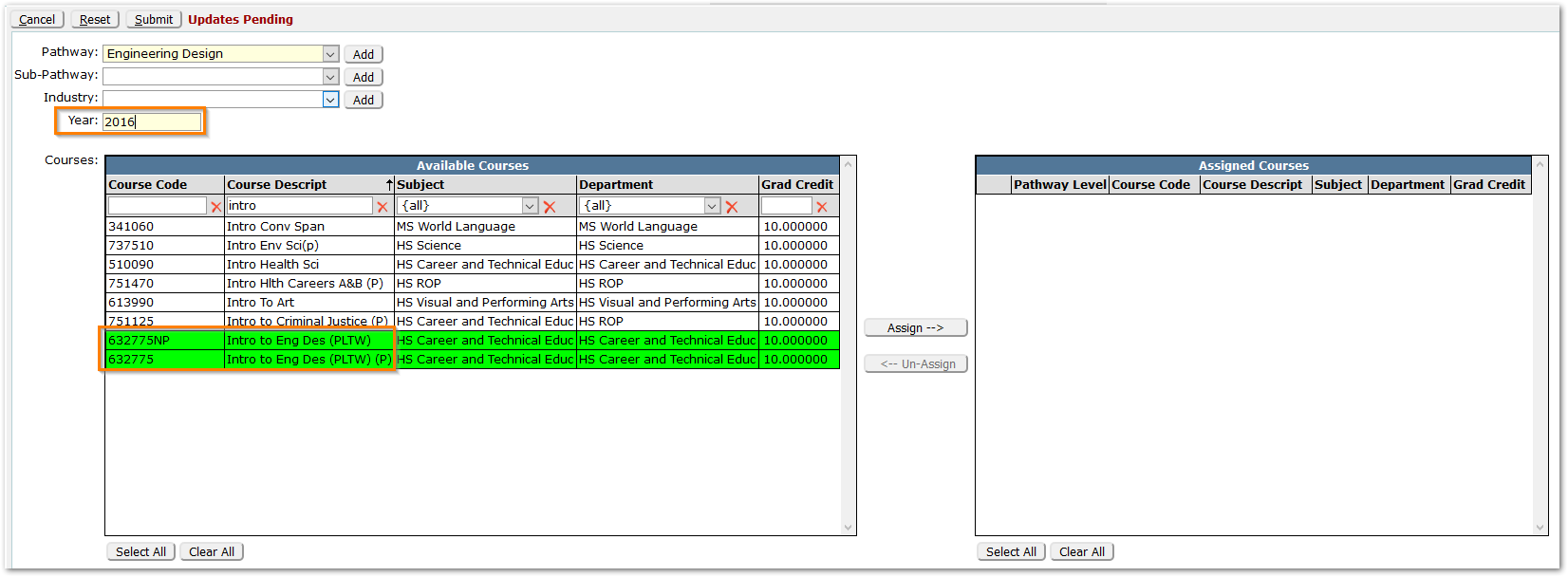
- Use the filter fields at the top of each column to find courses that apply to the Pathway.
In this example, we are adding ‘Intro to Engineering Design’ to the ‘Engineering Design’ Pathway. Districts often have multiple instances of a course reflecting differences, e.g. UC/CSU Approval, departments, etc. Be sure to include the correct versions or set of each course corresponding to those made available through Track Course Selection application to each School Track.
It’s important to be aware that during the process of assigning a student to a pathway, a counselor will be using either the Student Career Plan or Student Pathways applications and may need to select not only courses the student will take, but also for upper level students, the courses the student has already taken and for which they have transcript records that apply. In that event, it’s critical that all the variations of a course that apply to fulfill requirements are selected and assigned to the Pathway.
- Select the courses and click the Assign button.
- Select the Pathway Level for each course.
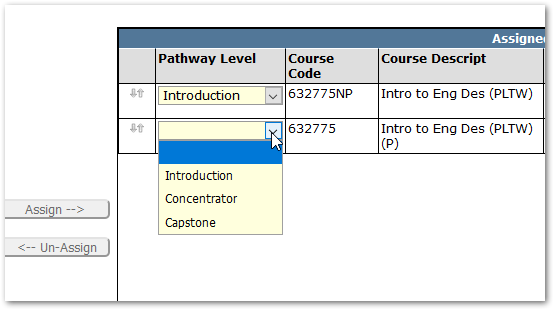
- After completing the Pathway, click Submit to save the record. The pathway will display in a list at left, with details of Courses, Effective year etc. displayed at right.
- Repeat these steps to continue to add remaining CTE Pathways.
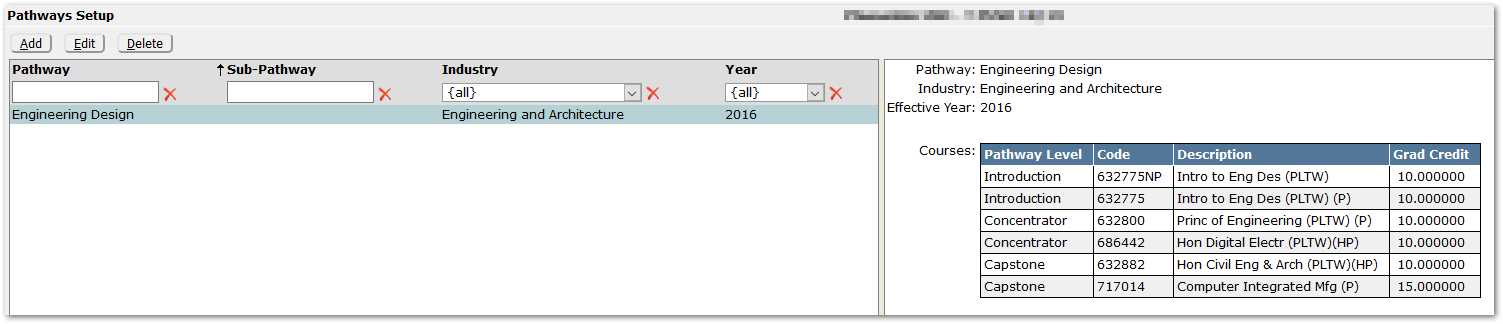
- To edit an existing pathway, click Edit and make desired changes.
The application will prevent the user from unassigning or removing a course if students in the Pathway have completed the course or have the course as an item in their Pathway.

When prevented from removing a course, the application will provide a list of students. To print the list, use the Printer icon in top right corner.
A Create New Pathway option is available. To create a variation of the Pathway, in the event of a change, use this function.
When Create New Pathway button is clicked, a copy of the pathway with the same courses selected is presented, prompting the user for a Year.
- Set a new Year value, different from the original pathway. Make any course selection or level adjustments and submit changes to save the Pathway.
In a situation where students have not yet completed a Pathway course, but do have the course in their Pathway as an item, a different message appears:

In this case, to remove the course, first edit and remove the course from each affected student’s Pathway. Then proceed to remove the course from the Pathway.
Alternately, use the Create New Pathway function to create a variation of the Pathway.
The Delete button for Pathways is only activated when the deletion of the pathway would not affect any students.